A custom storage bag is most useful when the buyer defines what goes inside, how it is loaded and where it will be kept between uses. A request for a medium bag with a zipper leaves too many practical questions open. The outside dimensions alone do not establish whether a bulky item can pass through the opening or whether the filled bag will fit its intended storage space. This guide is a buyer-side planning method, not a specification for an existing Guangshun product or a promise about load capacity, materials, price or lead time.
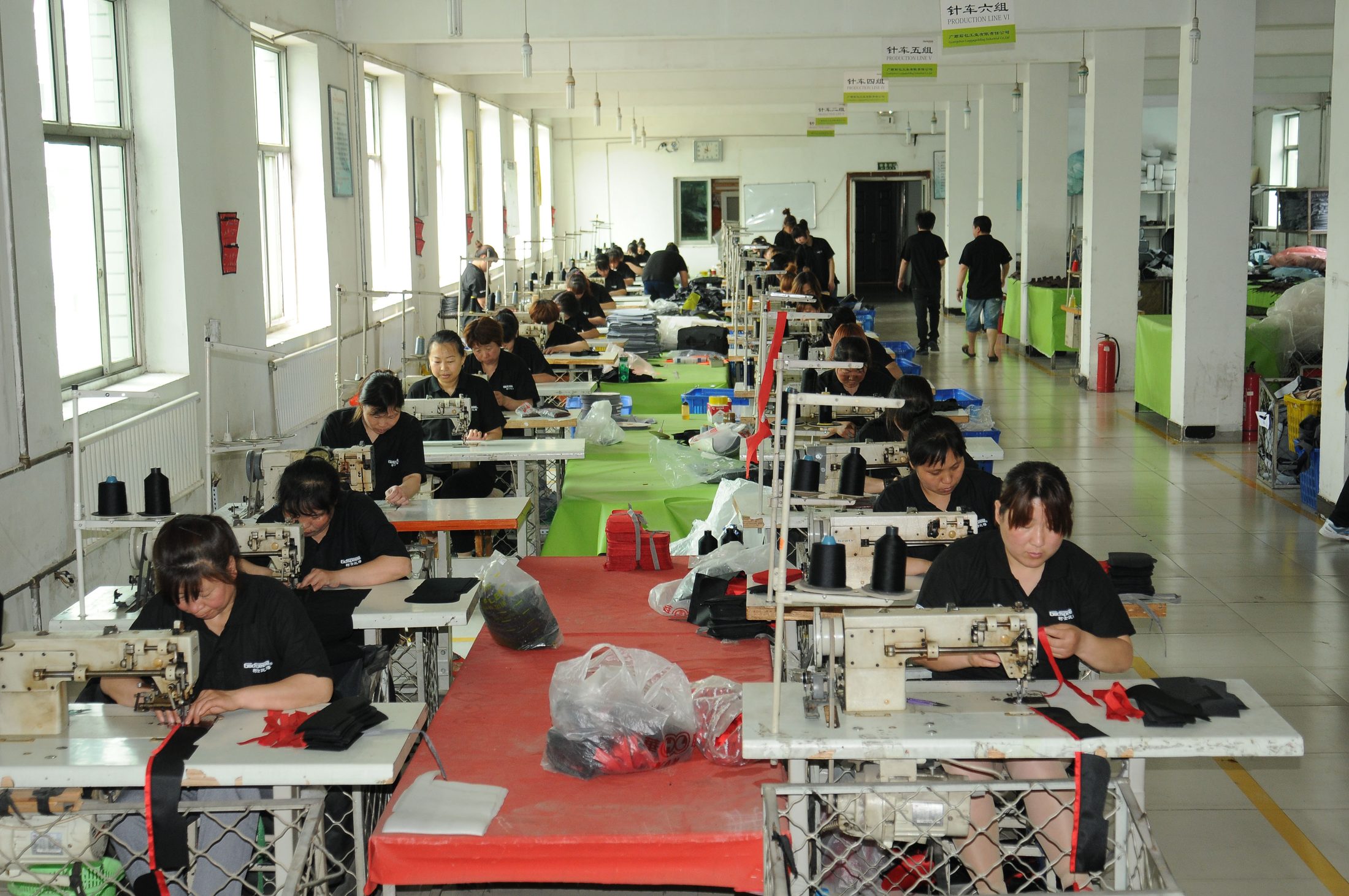
The cover photograph shows a sewing workshop. It does not show a finished storage bag or an approved sample for the example below.
Define the storage job before choosing a shape
List the actual items that need to be stored together. Record the largest packed dimensions of each item, including any sleeve, cable or attached part that remains with it. For soft contents, describe the packing condition you expect users to repeat, rather than giving only an approximate volume. Note whether one item must be removed without emptying the rest.
Decide where the bag will live: on a shelf, inside a larger carton, in a vehicle compartment or carried by hand. These are possible buyer scenarios, not factory-approved applications. Supply the usable dimensions of the intended space and the orientation in which the bag will be placed. If the bag is primarily for transport, list the actual carrying items and discuss handle placement separately. Do not infer a rated carrying capacity from a handle drawing.
| Buyer question | Information to supply | Sample check |
|---|---|---|
| What goes inside? | Item list and packed dimensions | Load the complete intended set |
| How does it enter? | Largest item and preferred loading direction | Pass the item through the real opening |
| Where is it stored? | Available space and placement orientation | Put the filled sample in that space |
| How often is it opened? | Retrieval and return sequence | Repeat the sequence with the bag filled |
| How is it moved? | Intended handling posture and contents | Review grip and access with the actual load |
The sample check column is about fit and usability only. Any strength or protective claim requires separately agreed requirements and evidence.
Measure the usable opening, not only the outside
Make a simple sketch showing the filled bag, its opening and the largest item. Mark whether that item enters lengthwise, sideways or at an angle. Ask the factory to confirm usable internal space and the clear opening on a physical sample. A proposed bag may have enough interior room while the opening shape makes loading inconvenient.
If several sizes are planned, prepare a separate item set for each size. Do not scale a small bag drawing and assume that the same closure position works for a larger load. Check the opening and filled form of each size with its intended contents.
Compare closures against the loading sequence
A zipper, drawcord or flap can be discussed as a design option, but the right choice depends on the contents and use. A zipper should be reviewed with the bag filled, checking whether the user can align and close it without moving contents away from the opening. For a drawcord, ask whether the resulting opening and closed shape suit the stored items. For a flap, check whether it reaches its intended fastening point in the filled condition. These are sample-review questions, not claims that any closure provides a particular protective performance.
Keep open decisions visible in the brief. If the buyer has not chosen a closure, ask the factory to propose feasible options for the selected form and document why one is preferred. Record the chosen construction on the approved sample rather than treating a reference photo as a complete instruction.
Run a compact sample review
- Load the full item set in the documented order and note any item that has no practical position.
- Close the bag without rearranging contents in a way the end user would not normally do.
- Place the filled bag in its intended storage space or carrying position and note interference.
- Open it and remove the priority item, then return that item and close it again.
- Repeat the sequence on each proposed size and record the sample revision for every change.
A small custom organizer pouch is a different brief when the main challenge is separating and finding small accessories. A soft-sided storage box or fabric bin is different again when maintaining a particular open form or folding flat is central to the design. Name the intended product by its actual use rather than treating these categories as synonyms.
Send one clear storage-bag brief
Provide the item inventory, packed measurements, storage-space dimensions, loading sketch, closure questions, handling needs and sample review notes. Include intended order quantity and destination market for project discussion, while leaving commercial terms and any performance requirement open for confirmation.
See the OEM / ODM workflow for the broader development process. To discuss custom storage bags, contact Guangshun Bags with your item list and reference drawings.